Guides - best ecommerce AI agents
Best ecommerce AI agents: what to compare
The best ecommerce AI agents are not just chat interfaces. They should own clear workflows, learn from performance, respect merchant guardrails, and connect actions to revenue. For ecommerce teams, the highest-value agents usually cover cart recovery, product recommendations, upsells, segmentation, email orchestration, and anomaly alerts.
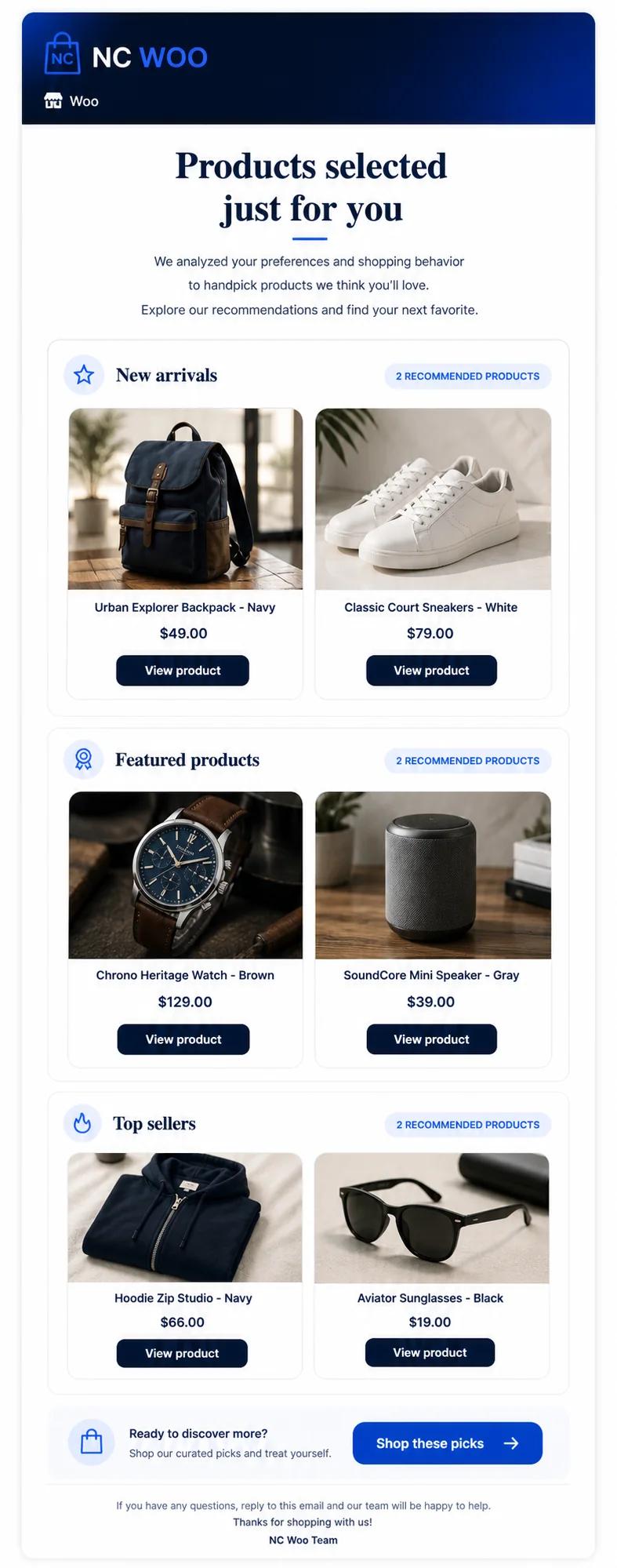
Product workflow evidence
Product example: an ecommerce advisor workflow using customer and product context.
This screen is shown as a concrete interface example. Results depend on store data, workflow rules, consent, and customer behavior; it is not a performance guarantee.
Problems
What usually blocks this workflow
- Many AI tools sound impressive but do not own specific ecommerce revenue workflows.
- Generic assistants may create ideas without executing or measuring the outcome.
- Teams need to compare practical capacity, integrations, and revenue visibility before testing.
Workflow
A practical implementation path
- 1Check whether each agent has a clear ecommerce mission and measurable outcome.
- 2Confirm the platform can use cart, customer, product, order, email, and revenue data.
- 3Review how the agents learn from results and stay inside business rules.
- 4Compare pricing, email capacity, supported stores, and onboarding effort.
Editorial guide
Compare agent systems with a reproducible test
Ask each vendor to process the same small set of store scenarios. Observe the input data, decision explanation, business controls, resulting action, and reporting. A reproducible test distinguishes an operational agent from a generated recommendation that still requires the team to assemble the workflow manually.
- Can the agent act on current store events and stop when context changes?
- Can operators inspect and constrain the decision?
- Can the system connect the action to a measurable commercial outcome?
Evaluate coordination, not only individual agents
The system should resolve conflicts between cart recovery, promotional email, support context, recommendations, and customer contact limits. Shared supervision and event history matter when several specialized agents operate on the same customer journey.
How NeuroCheckout helps
Applying this workflow with specialized ecommerce AI agents
NeuroCheckout is built for teams that want practical automation from store data. The goal is to connect signals to actions and keep the revenue impact visible.
- NeuroCheckout exposes 7 specialized ecommerce AI agents instead of one generic assistant.
- The platform is built around revenue actions such as recovery, recommendations, segmentation, upsell, email, and alerts.
- Pricing highlights email capacity and avoids customer-count pricing on Starter and Pro.
Metrics
What to measure
FAQ
Common questions
What should ecommerce AI agents do first?
They should focus on clear revenue workflows such as abandoned cart recovery, recommendations, segmentation, email orchestration, upsell, and anomaly detection.
Should I choose a specialist or a multi-agent platform?
A specialist can fit one narrow problem. A multi-agent platform fits better when several revenue workflows need to share the same store signals.
Next pages
Related ecommerce automation guides
ecommerce AI agents
Ecommerce AI agents for revenue automation
Open resourceAI revenue automation for ecommerce
AI revenue automation for ecommerce teams
Open resourceecommerce email automation without contact limits
Ecommerce email automation without contact limits
Open resourcebest abandoned cart recovery software