Guides - ecommerce personalization software
Ecommerce personalization software for revenue workflows
Ecommerce personalization software should help a store react to shopper intent across the buying journey. Product recommendations are part of that, but so are cart recovery, customer segmentation, personalized email timing, upsell decisions, and revenue alerts. NeuroCheckout fits this search when teams want personalization to become an operational workflow, not only a front-end experience.
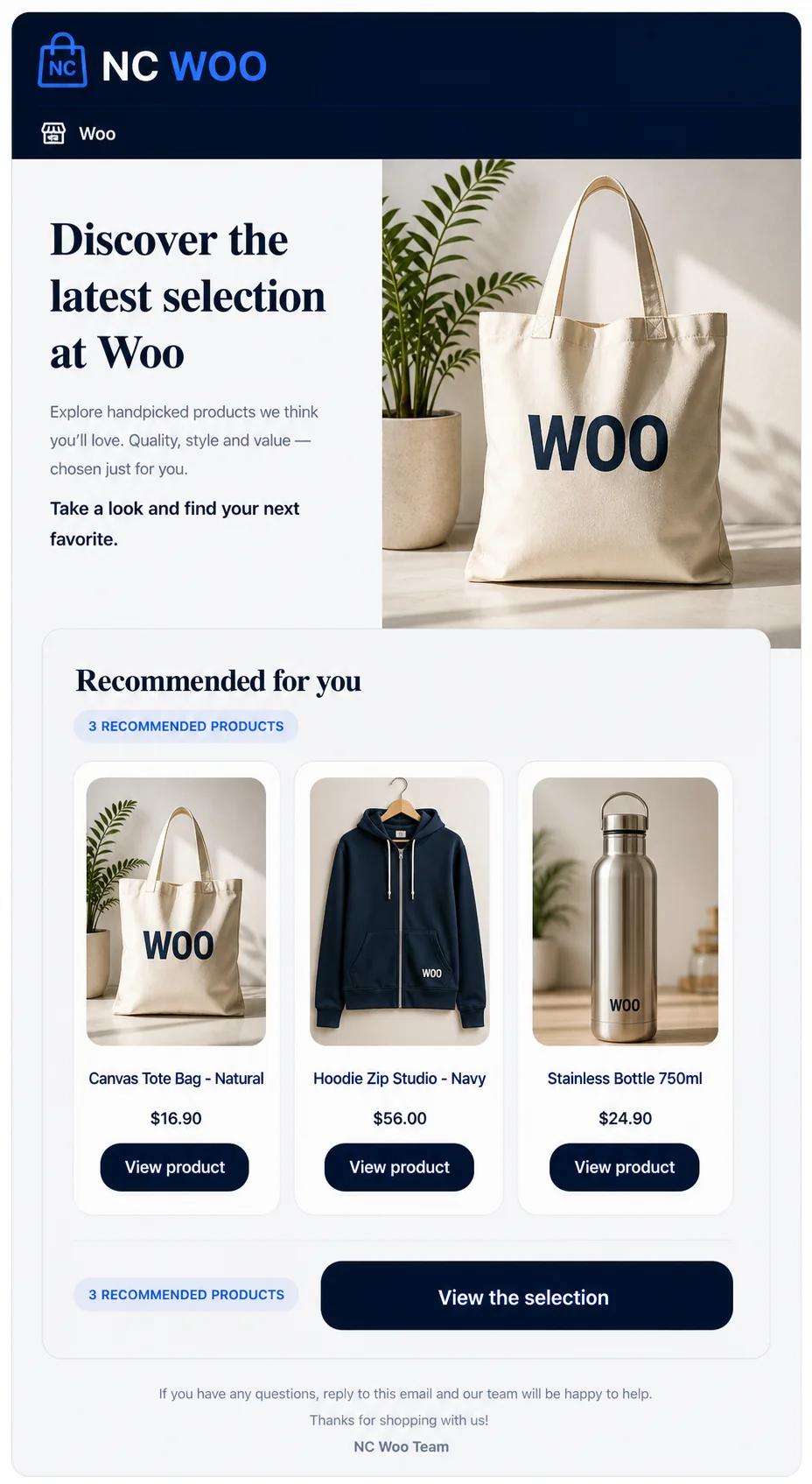
Product workflow evidence
Product example: personalized recommendations presented inside an ecommerce email workflow.
This screen is shown as a concrete interface example. Results depend on store data, workflow rules, consent, and customer behavior; it is not a performance guarantee.
Problems
What usually blocks this workflow
- Onsite personalization can stay isolated from email, cart recovery, and customer lifecycle workflows.
- Manual personalization rules become hard to maintain when products, segments, and campaigns change.
- Engagement metrics do not always show whether personalization created revenue.
Workflow
A practical implementation path
- 1Bring product, customer, cart, order, and campaign signals into one operating layer.
- 2Use AI agents to identify intent, product affinity, customer stage, and recovery opportunity.
- 3Activate personalization through recommendations, email workflows, segments, and upsell actions.
- 4Measure conversion, order value, recovered revenue, and segment-level performance.
Editorial guide
Build a usable customer context layer
Personalization depends on resolving events into a consistent customer and session history. Before selecting advanced tactics, verify how anonymous browsing, identified customers, orders, product interactions, consent, and message outcomes are joined. Missing identity rules often create more noise than a simple segment-based approach.
- Document event sources and identity resolution rules.
- Separate real-time context from slower analytical attributes.
- Define safe defaults when data is incomplete or conflicting.
Prefer controlled decisions over unlimited variation
A merchant should be able to understand which attributes affected a decision and which business rule constrained it. Start with a small number of high-value placements, establish a baseline, and expand only when relevance, conversion, and customer experience remain measurable.
How NeuroCheckout helps
Applying this workflow with specialized ecommerce AI agents
NeuroCheckout is built for teams that want practical automation from store data. The goal is to connect signals to actions and keep the revenue impact visible.
- NeuroCheckout connects personalization with recommendation, recovery, segmentation, upsell, and alert agents.
- The platform is built for ecommerce teams that want AI actions tied to revenue metrics.
- No customer-count pricing helps teams keep customer data available for better personalization signals.
Metrics
What to measure
FAQ
Common questions
Is personalization only about product widgets?
No. Useful ecommerce personalization also affects cart recovery, email timing, customer segments, upsell offers, and revenue monitoring.
When should a store test personalization software?
Test it when the store has enough product, customer, cart, or order data to make different actions useful for different shoppers.
Next pages
Related ecommerce automation guides
ecommerce product recommendation engine
Ecommerce product recommendation engine with AI agents
Open resourceAI product recommendations ecommerce
AI product recommendations for ecommerce growth
Open resourceNosto alternative AI personalization
Nosto alternative for ecommerce AI personalization
Open resourceAI upsell cross-sell ecommerce