Use cases - AI product recommendations ecommerce
AI product recommendations for ecommerce growth
AI product recommendations help stores present the right items at the right moment. The strongest recommendation workflows use product relationships, purchase history, browsing behavior, cart contents, and customer segments rather than a generic best-seller list.
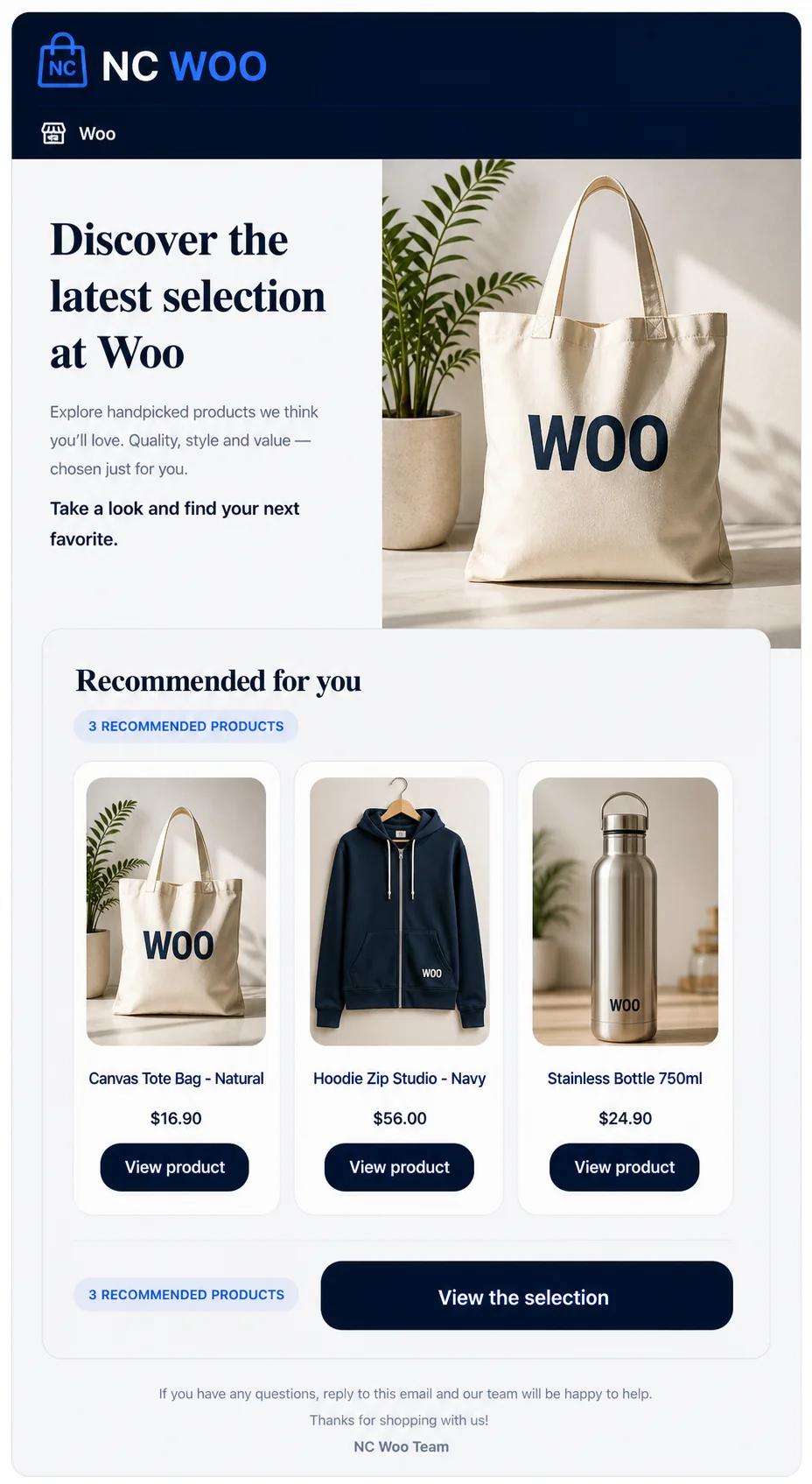
Product workflow evidence
Product example: personalized recommendations presented inside an ecommerce email workflow.
This screen is shown as a concrete interface example. Results depend on store data, workflow rules, consent, and customer behavior; it is not a performance guarantee.
Problems
What usually blocks this workflow
- Static product blocks often show irrelevant items and do not adapt to customer intent.
- Recommendation tools can be disconnected from cart recovery and email automation.
- Teams need to know which recommendations are actually contributing to revenue.
Workflow
A practical implementation path
- 1Synchronize products, orders, carts, and customer behavior.
- 2Identify complementary, substitute, repeat-purchase, and high-margin product opportunities.
- 3Use recommendations inside emails, recovery flows, upsell moments, and dashboard insights.
- 4Track click-through, conversion, order value, and recommendation-assisted revenue.
Editorial guide
Match recommendation logic to the placement
A product page, cart, post-purchase message, and re-engagement email answer different customer questions. Use affinity, compatibility, availability, price range, and purchase history according to that context. A recommendation that is plausible in isolation can still be unhelpful when it repeats an owned product or ignores the current cart.
- Define the customer question for each placement.
- Apply inventory, compatibility, margin, and repetition rules before ranking.
- Keep a fallback for new customers and sparse product data.
Evaluate relevance and commercial impact together
Click-through rate can reveal interest, while recommendation conversion, incremental revenue, average order value, return rate, and coverage reveal business quality. Review underperforming products and segments, not only the aggregate result, so high-volume items do not hide weak relevance elsewhere.
How NeuroCheckout helps
Applying this workflow with specialized ecommerce AI agents
NeuroCheckout is built for teams that want practical automation from store data. The goal is to connect signals to actions and keep the revenue impact visible.
- The recommendation agent can work alongside cart recovery and segmentation agents.
- NeuroCheckout focuses recommendations on measurable revenue outcomes.
- The platform is useful when you want recommendations to become part of wider ecommerce automation.
Metrics
What to measure
FAQ
Common questions
Do AI recommendations require a huge catalog?
No, but they work best when there is enough product, order, or behavior data to identify useful relationships.
Where should recommendations appear?
Common placements include cart recovery emails, product pages, post-purchase flows, customer segments, and campaign suggestions.
Next pages
Related ecommerce automation guides
ecommerce product recommendation engine
Ecommerce product recommendation engine with AI agents
Open resourceecommerce personalization software
Ecommerce personalization software for revenue workflows
Open resourceRebuy alternative AI recommendations
Rebuy alternative for AI product recommendations
Open resourceAI upsell cross-sell ecommerce