Guides - ecommerce product recommendation engine
Ecommerce product recommendation engine with AI agents
An ecommerce product recommendation engine helps shoppers find relevant products by using catalog, cart, purchase, and behavior signals. The best implementation is not only a widget on a product page. Recommendations should also support recovery emails, customer segments, upsell moments, and revenue monitoring so the store can see whether personalization actually changes sales.
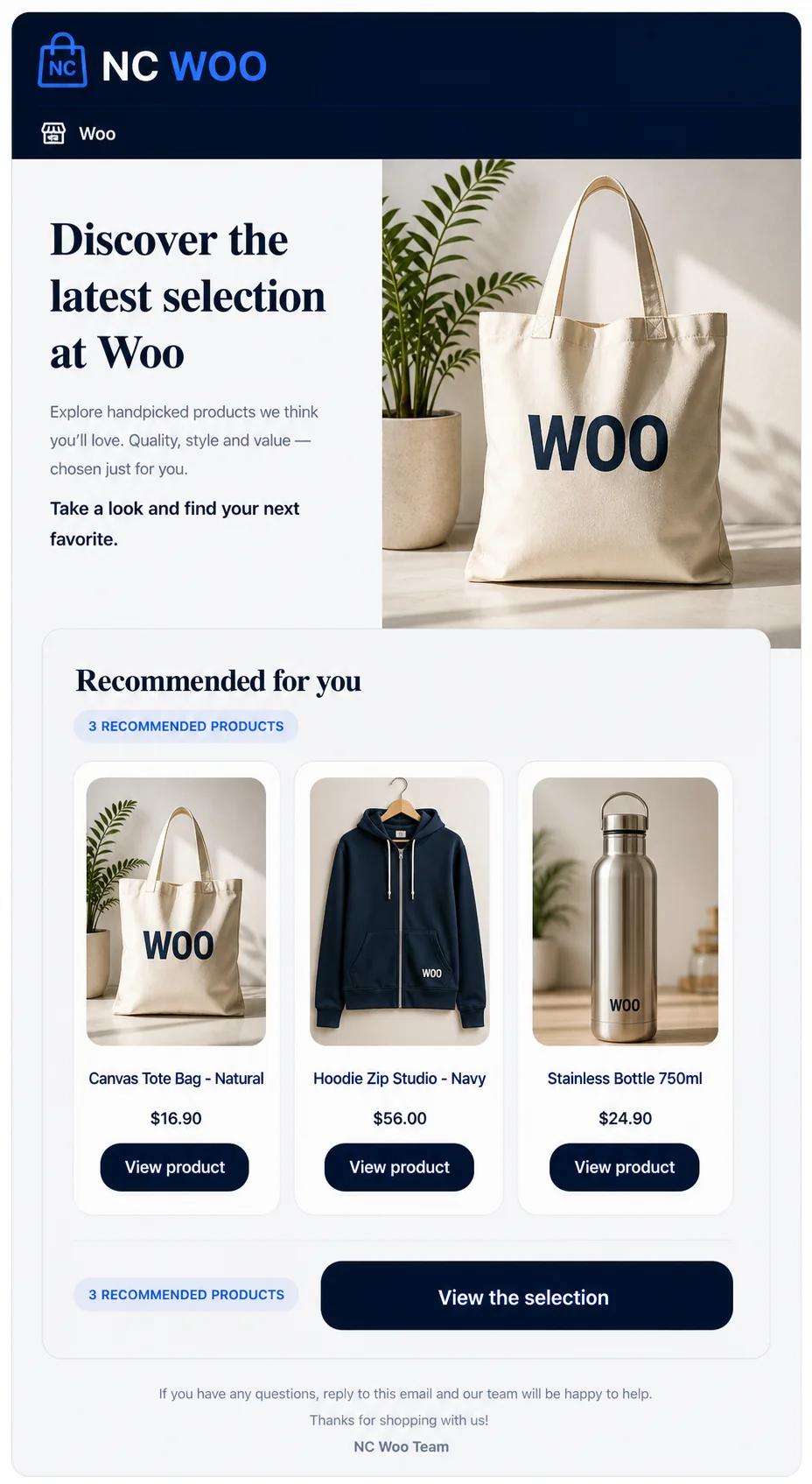
Product workflow evidence
Product example: personalized recommendations presented inside an ecommerce email workflow.
This screen is shown as a concrete interface example. Results depend on store data, workflow rules, consent, and customer behavior; it is not a performance guarantee.
Problems
What usually blocks this workflow
- Best-seller blocks become less useful as catalog size, customer segments, and shopping intent become more varied.
- Recommendation tools can optimize clicks while staying disconnected from recovery, email, and segment workflows.
- Teams need a clear view of recommendation-assisted revenue, not only impressions.
Workflow
A practical implementation path
- 1Connect product catalog, order, cart, and customer signals.
- 2Identify product relationships such as complements, substitutes, upgrades, replenishment, and affinity clusters.
- 3Use recommendations across product pages, cart recovery emails, upsell flows, and customer segments.
- 4Measure recommendation clicks, assisted orders, order value, and repeat purchase impact.
How NeuroCheckout helps
Applying this workflow with specialized ecommerce AI agents
NeuroCheckout is built for teams that want practical automation from store data. The goal is to connect signals to actions and keep the revenue impact visible.
- NeuroCheckout treats product recommendations as an agent workflow connected to cart recovery and segmentation.
- Recommendations can inform emails, upsells, customer groups, and revenue alerts from the same store signals.
- The platform is useful when ecommerce teams want recommendations to support measurable revenue actions.
Metrics
What to measure
FAQ
Common questions
What data does an ecommerce recommendation engine need?
Useful inputs include products, categories, carts, orders, customer history, inventory context, and engagement events.
Where should recommendations be used first?
Start with cart recovery emails, product pages, and upsell moments because those placements connect directly to purchase intent.
Next pages
Related ecommerce automation guides
AI product recommendations ecommerce
AI product recommendations for ecommerce growth
Open resourceAI upsell cross-sell ecommerce
AI upsell and cross-sell automation for ecommerce
Open resourceRebuy alternative AI recommendations
Rebuy alternative for AI product recommendations
Open resourceecommerce personalization software