Guides - AI abandoned cart recovery tools
AI abandoned cart recovery tools: what ecommerce teams need
AI abandoned cart recovery tools are useful when a store needs more than a basic reminder email. The strongest tools use cart value, product mix, shopper history, channel consent, timing, and past recovery outcomes to decide how each abandoned cart should be handled. For NeuroCheckout, this keyword matters because cart recovery is often the fastest path from AI automation to measurable revenue.
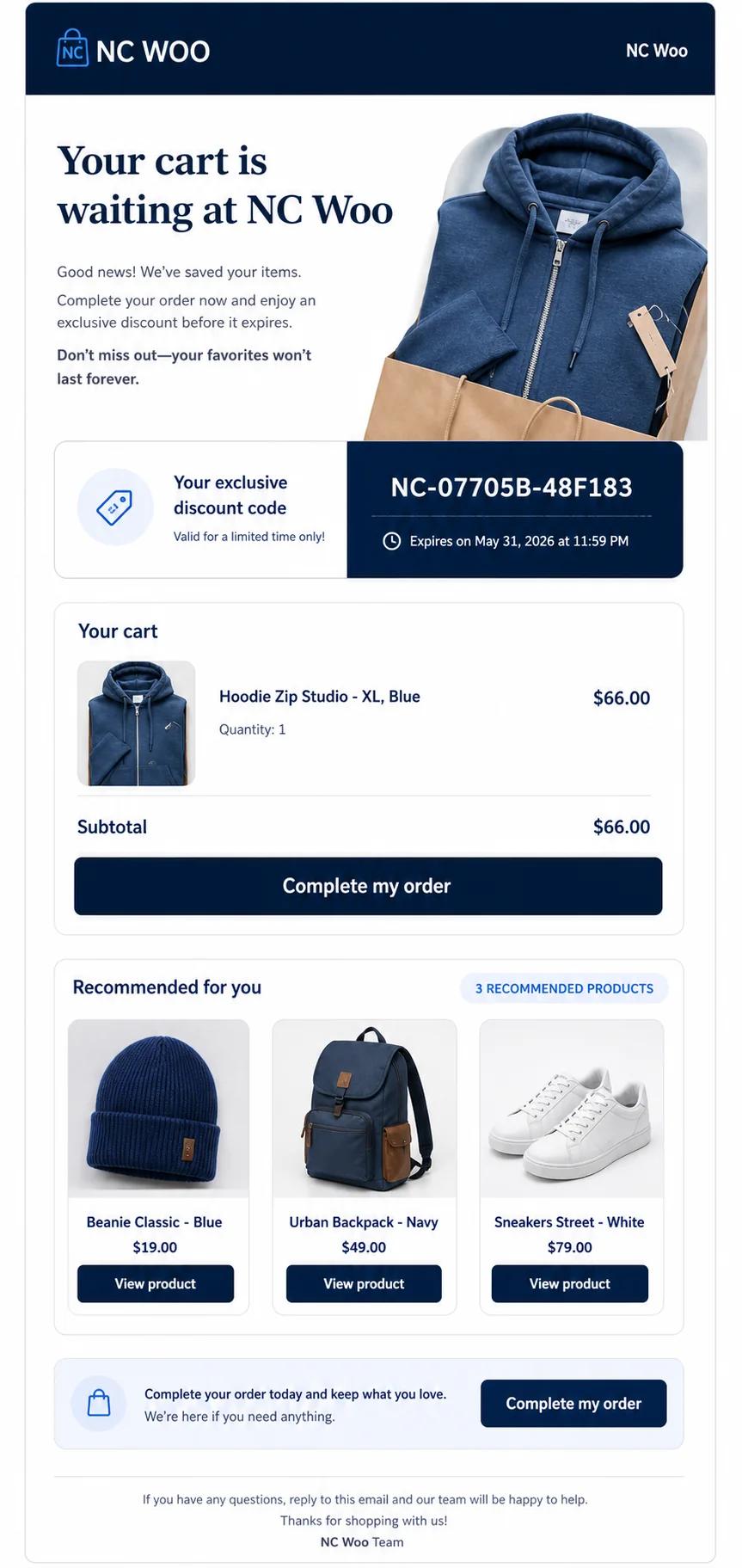
Product workflow evidence
Product example: a recovery email assembled from current cart and product context.
This screen is shown as a concrete interface example. Results depend on store data, workflow rules, consent, and customer behavior; it is not a performance guarantee.
Problems
What usually blocks this workflow
- A fixed cart reminder flow cannot tell the difference between a first-time visitor, a returning customer, and a high-value cart.
- Discount-heavy recovery can erode margin when every abandoned cart receives the same offer.
- Many recovery tools report opens and clicks without showing which actions actually recovered orders.
Workflow
A practical implementation path
- 1Capture abandoned cart, customer, product, order, and revenue events from the ecommerce platform.
- 2Segment carts by value, timing, customer history, product category, and available consent.
- 3Choose the right recovery action: reminder, product reassurance, recommendation, offer escalation, or no send.
- 4Track recovered orders, recovered revenue, conversion rate, complaint rate, and margin impact.
Editorial guide
A practical cart recovery tool scorecard
Compare tools against the complete operating workflow. Data freshness and exclusion logic matter as much as the editor used to write a message. The strongest evaluation starts with a small set of representative carts and verifies every transition from abandonment detection to attribution.
- Store event coverage and synchronization delay.
- Consent, suppression, frequency, inventory, and discount controls.
- Product context, sequence branching, conversion attribution, and audit history.
Run the same acceptance test for every vendor
Create a cart, wait for the eligibility window, complete or cancel the order at different points, and confirm that the workflow reacts correctly. Repeat with a returning customer, an out-of-stock item, and a customer at the communication limit. This exposes operational gaps that a feature checklist cannot show.
How NeuroCheckout helps
Applying this workflow with specialized ecommerce AI agents
NeuroCheckout is built for teams that want practical automation from store data. The goal is to connect signals to actions and keep the revenue impact visible.
- NeuroCheckout includes an Abandoned Cart Recovery agent as part of a broader ecommerce revenue automation stack.
- Cart recovery can use recommendation and segmentation signals instead of acting as an isolated email sequence.
- Starter and Pro make the test easy to budget with visible email capacity and no customer-count pricing.
Metrics
What to measure
FAQ
Common questions
What makes an AI abandoned cart recovery tool different?
It can adapt the recovery path to cart value, product context, customer history, timing, and consent instead of sending the same sequence to every shopper.
Should AI cart recovery always use multiple channels?
No. Multiple channels help only when consent, customer preference, and order deduplication are handled correctly. Email-first recovery can still work well when it is personalized and measured by revenue.
Next pages
Related ecommerce automation guides
AI abandoned cart recovery
AI abandoned cart recovery for Shopify, WooCommerce and more
Open resourcebest abandoned cart recovery software
Best abandoned cart recovery software: what to look for
Open resourceShopify AI cart recovery agent
Shopify AI cart recovery agent for abandoned carts
Open resourcecart abandonment AI agent