Use cases - AI abandoned cart recovery
AI abandoned cart recovery for Shopify, WooCommerce and more
Abandoned cart recovery is one of the highest-intent ecommerce workflows because the shopper has already shown purchase intent. Baymard's 2026 cart abandonment benchmark reports an average documented abandonment rate above 70 percent, which makes recovery a structural revenue workflow rather than a seasonal campaign. AI helps by adapting timing, message angle, products shown, and escalation based on cart value, customer history, and behavior.
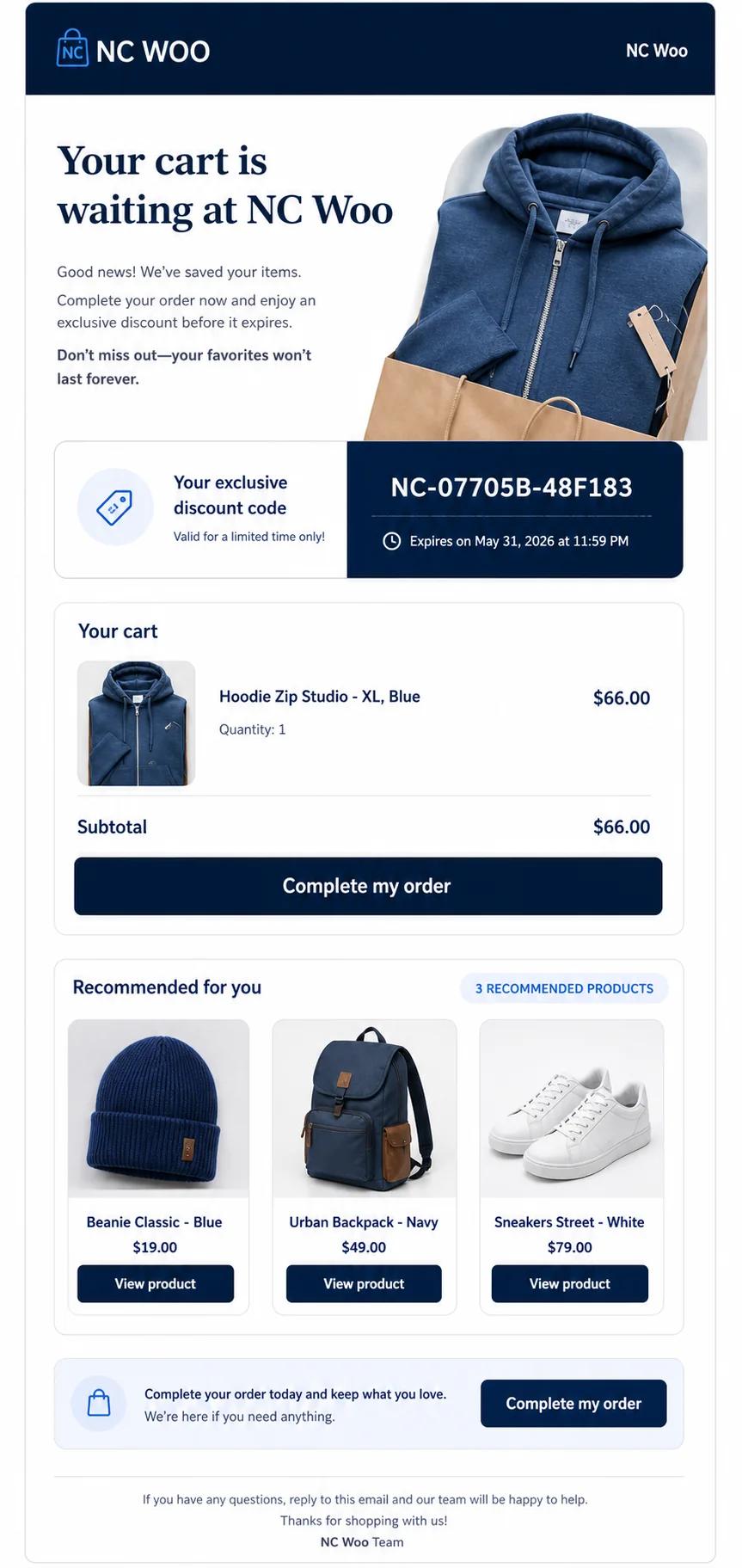
Product workflow evidence
Product example: a recovery email assembled from current cart and product context.
This screen is shown as a concrete interface example. Results depend on store data, workflow rules, consent, and customer behavior; it is not a performance guarantee.
Problems
What usually blocks this workflow
- Static reminders treat every abandoned cart the same, even when cart value and customer intent differ.
- Teams often cannot see which recovery actions generate revenue and which create noise.
- Follow-ups are usually disconnected from product recommendations, customer segments, and campaign rules.
- Discount-first recovery can train shoppers to wait for coupons and can erode margin when every cart receives the same offer.
Workflow
A practical implementation path
- 1Collect cart, checkout, product, and customer signals from the connected ecommerce platform.
- 2Analyze the cart value, shopper context, product mix, consent, and time since abandonment.
- 3Decide which follow-up timing and message angle fit the specific abandonment.
- 4Trigger product-aware recovery email when eligible, then stop the workflow as soon as the order is recovered.
- 5Measure recovered orders, recovered revenue, conversion rate, discount use, and agent contribution.
Editorial guide
Treat abandonment as a structural revenue leak
Baymard's 2026 benchmark reports an average documented online shopping cart abandonment rate above 70 percent. That does not mean every cart is recoverable, but it does mean every store should treat abandonment as an operating workflow with detection, eligibility, timing, message quality, and measurement.
- Source: Baymard Institute, 50 Cart Abandonment Rate Statistics 2026, baymard.com/lists/cart-abandonment-rate.
- Do not assume every abandoned cart needs the same action.
- Measure recovered revenue and margin impact, not only sends and opens.
Use timing and product context before incentives
A useful recovery workflow preserves the abandoned cart context, chooses the follow-up moment carefully, and starts with relevance before defaulting to a coupon. BigCommerce's abandoned cart guidance also recommends using incentives strategically instead of making every first reminder discount-led.
- Reference the cart and products clearly so the shopper understands why the message exists.
- Keep a single primary call to action back to checkout.
- Reserve incentives for shoppers or moments where the extra margin tradeoff is justified.
Connect A-C-R to the rest of the revenue system
A-C-R should not behave like an isolated reminder flow. Cart recovery becomes stronger when it shares context with segmentation, product recommendations, email orchestration, and revenue alerts, while still respecting consent, frequency limits, completed orders, and discount controls.
- Stop recovery after a matching order is placed.
- Avoid sending a cart reminder at the same time as an unrelated campaign when pressure limits apply.
- Review recovered revenue, time to recovery, discount usage, and complaint rate together.
Source notes
This page avoids unsupported claims such as fixed competitor-purchase percentages or guaranteed conversion multiples. The public benchmarks are used only to explain why abandoned cart recovery deserves operational attention.
- Baymard cart abandonment benchmark: baymard.com/lists/cart-abandonment-rate.
- BigCommerce abandoned cart email best practices: bigcommerce.com/articles/ecommerce/abandoned-cart-emails/.
How NeuroCheckout helps
Applying this workflow with specialized ecommerce AI agents
NeuroCheckout is built for teams that want practical automation from store data. The goal is to connect signals to actions and keep the revenue impact visible.
- A-C-R is the NeuroCheckout agent dedicated to abandoned cart recovery and revenue recovery.
- Cart recovery can work alongside segmentation, product recommendation, email orchestration, and revenue alert workflows.
- The dashboard keeps recovered orders and revenue visible so the workflow can be evaluated over time.
- Starter and Pro pricing is based on stores, agents, and email capacity, not the number of synced contacts.
Metrics
What to measure
FAQ
Common questions
Why use AI for abandoned cart recovery?
AI can adapt recovery workflows to cart value, product context, timing, and customer signals instead of sending the same sequence to every shopper.
Does cart recovery need discounts?
Not always. Many carts can be recovered with better timing, clearer product reminders, useful recommendations, or reassurance before a discount is needed.
Does A-C-R work with Shopify and WooCommerce?
NeuroCheckout supports Shopify, WooCommerce, PrestaShop, and Magento through dedicated connector modules, so the recovery workflow can start from real store events.
Will pricing increase as the abandoned cart list grows?
Starter and Pro are not priced by the number of synced ecommerce contacts. Plan limits focus on connected stores, active agents, and email capacity.
Next pages
Related ecommerce automation guides
AI abandoned cart recovery tools
AI abandoned cart recovery tools: what ecommerce teams need
Open resourcecart abandonment AI agent
Cart abandonment AI agent for ecommerce recovery
Open resourceShopify AI cart recovery agent
Shopify AI cart recovery agent for abandoned carts
Open resourceWooCommerce abandoned cart recovery AI