Use cases - AI revenue automation for ecommerce
AI revenue automation for ecommerce teams
AI revenue automation means turning store signals into actions that can recover sales, increase order value, improve relevance, and detect problems early. NeuroCheckout does this with 7 specialized ecommerce AI agents managed by a Supervisor layer focused on measurable revenue outcomes.
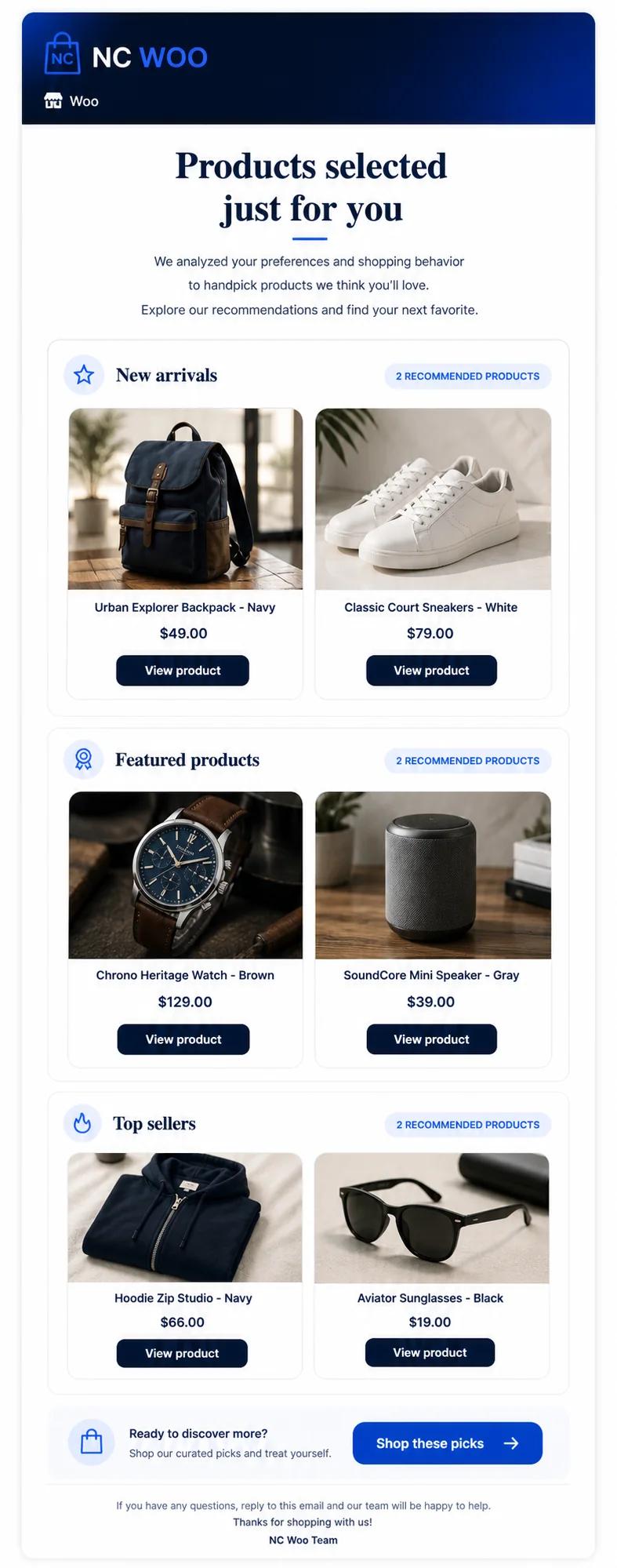
Product workflow evidence
Product example: an ecommerce advisor workflow using customer and product context.
This screen is shown as a concrete interface example. Results depend on store data, workflow rules, consent, and customer behavior; it is not a performance guarantee.
Problems
What usually blocks this workflow
- Store data is often scattered across cart, email, analytics, and product tools.
- Teams see performance reports but still need to decide which action to take.
- Generic AI assistants do not usually own ecommerce workflows such as recovery, upsell, segmentation, and anomaly alerts.
Workflow
A practical implementation path
- 1Connect store data such as carts, orders, products, customers, emails, and revenue events.
- 2Route each signal to the right specialized agent.
- 3Let agents trigger or recommend revenue actions within merchant-defined guardrails.
- 4Measure recovered revenue, conversion, order value, and workflow performance.
Editorial guide
Create a revenue action map
List the recurring signals the team already monitors, the decision each signal requires, and the person or system that acts today. Prioritize workflows with frequent events, clear eligibility, reversible actions, and measurable outcomes. This prevents automation from starting with broad goals that cannot be audited.
- Signal: what changed and how quickly must it be detected?
- Decision: what context and guardrails determine the next step?
- Outcome: what metric proves the action helped after costs and exclusions?
Supervise exceptions before expanding autonomy
Review cases where data is missing, several workflows compete, or the recommended action approaches a business limit. Exception logs reveal where rules need refinement. Expand automation only after normal cases and stop conditions are dependable.
How NeuroCheckout helps
Applying this workflow with specialized ecommerce AI agents
NeuroCheckout is built for teams that want practical automation from store data. The goal is to connect signals to actions and keep the revenue impact visible.
- NeuroCheckout is positioned as an ecommerce AI control tower for revenue actions.
- The 7 agents cover product advice, cart recovery, recommendations, upsell, segmentation, email orchestration, and anomaly alerts.
- Starter and Pro keep capacity easy to understand with visible email quotas and no customer-count pricing.
Metrics
What to measure
FAQ
Common questions
What is AI revenue automation?
It is the use of AI to detect ecommerce revenue signals and turn them into actions such as cart recovery, recommendations, upsells, segmentation, email workflows, and alerts.
How is this different from analytics?
Analytics shows what happened. Revenue automation connects the signal to an action and measures whether that action created value.
Next pages
Related ecommerce automation guides
ecommerce AI agents
Ecommerce AI agents for revenue automation
Open resourcebest ecommerce AI agents
Best ecommerce AI agents: what to compare
Open resourceAI ecommerce revenue monitoring
AI revenue monitoring for ecommerce operations
Open resourcecustomer support revenue signal