Guides - ecommerce AI agents
Ecommerce AI agents for revenue automation
Ecommerce AI agents are specialized automation workers that watch store signals, decide what needs attention, and trigger useful revenue actions. For most online stores, the opportunity is not one more dashboard. It is a coordinated layer that can recover abandoned carts, personalize recommendations, segment customers, trigger upsells, automate email workflows, and surface revenue anomalies before they become invisible losses.
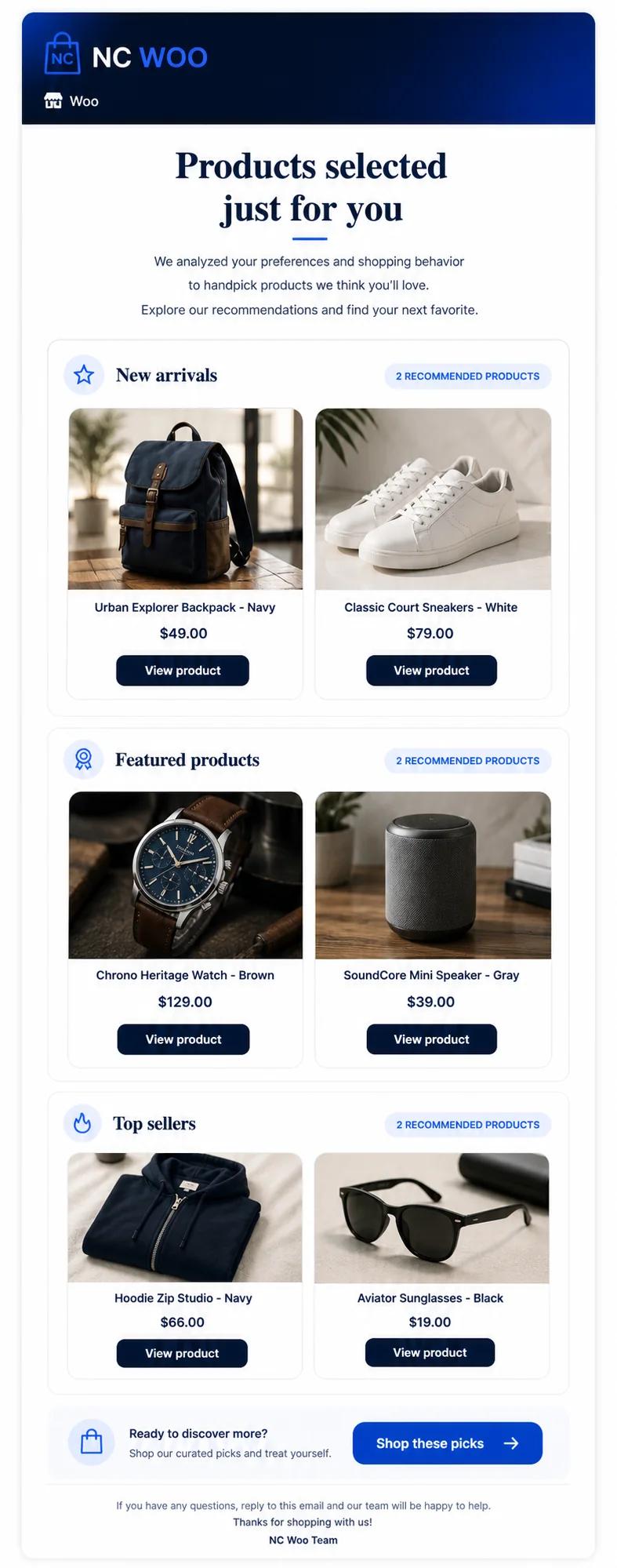
Product workflow evidence
Product example: an ecommerce advisor workflow using customer and product context.
This screen is shown as a concrete interface example. Results depend on store data, workflow rules, consent, and customer behavior; it is not a performance guarantee.
Problems
What usually blocks this workflow
- Cart, product, customer, email, and revenue data are scattered across separate tools.
- Teams see reports after the fact, but do not always know which action to take next.
- Generic chatbots do not handle the operational workflows that actually move ecommerce revenue.
Workflow
A practical implementation path
- 1Connect the store and synchronize carts, orders, products, customers, and revenue events.
- 2Detect signals such as abandoned carts, product affinity, purchase timing, segment behavior, and revenue anomalies.
- 3Route each signal to the right agent: recovery, recommendations, segmentation, email orchestration, upsell, or revenue alerts.
- 4Measure recovered revenue, conversion lift, email performance, and agent-level contribution.
Editorial guide
Start with decisions, not an AI feature list
A useful ecommerce agent owns a bounded decision: it observes a defined signal, chooses from permitted actions, records what happened, and feeds the outcome back into the next decision. This makes the workflow testable. A generic assistant that only produces text may help a team move faster, but it does not become an operational agent until its inputs, actions, limits, and success metric are explicit.
- Define the signal and the business event that starts the workflow.
- List permitted actions, approval rules, frequency limits, and stop conditions.
- Choose one primary outcome and the diagnostic metrics needed to explain it.
Use one feedback loop across the agent stack
Cart recovery, recommendations, segmentation, email orchestration, upsells, and anomaly alerts should not optimize in isolation. A recovered order changes customer context; a recommendation click changes product affinity; an unsubscribe changes communication eligibility. A shared event history reduces contradictory actions and gives operators one place to audit why an action occurred.
How NeuroCheckout helps
Applying this workflow with specialized ecommerce AI agents
NeuroCheckout is built for teams that want practical automation from store data. The goal is to connect signals to actions and keep the revenue impact visible.
- NeuroCheckout is designed as a multi-agent ecommerce platform rather than a single generic assistant.
- Each agent has a clear business mission, which makes the automation easier to evaluate.
- The Supervisor layer keeps the system focused on revenue signals and measurable actions.
Metrics
What to measure
FAQ
Common questions
Are ecommerce AI agents the same as chatbots?
No. A chatbot mostly answers messages. Ecommerce AI agents are built around operational workflows such as cart recovery, recommendations, segmentation, campaign orchestration, and revenue monitoring.
Which stores benefit first from AI agents?
Stores with recurring traffic, abandoned carts, enough product variety, and regular order data usually benefit first because they already have signals the agents can act on.
Next pages
Related ecommerce automation guides
AI models for ecommerce
AI models for ecommerce automation
Open resourceAI abandoned cart recovery
AI abandoned cart recovery for Shopify, WooCommerce and more
Open resourceAI product recommendations ecommerce
AI product recommendations for ecommerce growth
Open resourceAI ecommerce revenue monitoring