Use cases - ecommerce email marketing automation
Ecommerce email marketing automation with AI agents
Email marketing remains one of the most direct ecommerce revenue channels, but it becomes harder to manage when every flow, segment, and product rule is manual. AI agents can help by selecting triggers, adapting content, and connecting email actions to revenue outcomes.
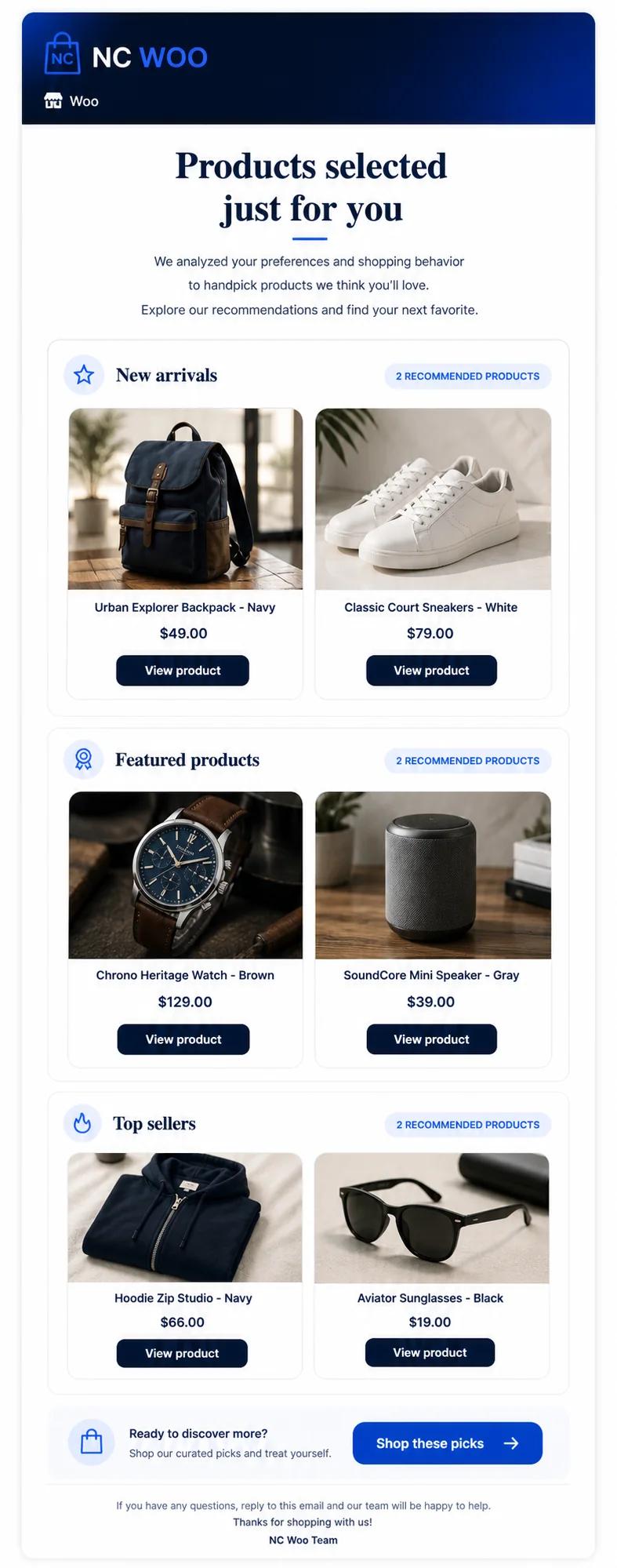
Product workflow evidence
Product example: an ecommerce advisor workflow using customer and product context.
This screen is shown as a concrete interface example. Results depend on store data, workflow rules, consent, and customer behavior; it is not a performance guarantee.
Problems
What usually blocks this workflow
- Manual campaign setup creates slow feedback loops for small ecommerce teams.
- Email tools often separate content creation from cart, order, and recommendation signals.
- Teams need revenue monitoring, not only opens and clicks.
Workflow
A practical implementation path
- 1Connect ecommerce events to email triggers such as abandonment, repeat purchase, and customer segment changes.
- 2Use AI agents to draft and adapt product-aware emails.
- 3Coordinate messages with recommendation, segmentation, and revenue alert workflows.
- 4Review revenue, conversion, and deliverability performance from one dashboard.
Editorial guide
Design lifecycle orchestration around eligibility
A customer can qualify for several campaigns at once. Orchestration decides which message has priority, whether another workflow should pause, and when the customer is no longer eligible. This coordination prevents a promotional send from colliding with cart recovery, post-purchase service, or a recent opt-out.
- Set global and workflow-specific contact limits.
- Create priority and suppression rules across sequences.
- Use conversion, consent, and order events as immediate stop conditions.
Separate deliverability, engagement, and revenue diagnostics
Delivery and complaint signals protect sender health. Opens and clicks help diagnose content and placement. Conversion, attributed revenue, margin, and unsubscribe behavior describe commercial impact. Keeping these layers separate makes it easier to identify whether a weak result starts with reach, relevance, or the offer itself.
How NeuroCheckout helps
Applying this workflow with specialized ecommerce AI agents
NeuroCheckout is built for teams that want practical automation from store data. The goal is to connect signals to actions and keep the revenue impact visible.
- NeuroCheckout treats email as part of a revenue automation system, not an isolated channel.
- Email orchestration can use abandoned cart, recommendation, and segmentation signals.
- Performance tracking is built around ecommerce outcomes such as recovered orders and revenue.
Metrics
What to measure
FAQ
Common questions
Can AI replace an email marketing team?
AI should reduce manual workflow setup and surface better actions, but teams still need to review positioning, offers, and brand fit.
Which ecommerce emails should be automated first?
Start with abandoned cart recovery, product recommendations, post-purchase follow-ups, winback segments, and revenue anomaly alerts.
Next pages
Related ecommerce automation guides
Klaviyo alternative ecommerce AI
Klaviyo alternative for ecommerce AI agents
Open resourceOmnisend alternative ecommerce AI
Omnisend alternative for AI ecommerce automation
Open resourceAI customer segmentation ecommerce
AI customer segmentation for ecommerce teams
Open resourceecommerce email automation without contact limits